Heavy Truck & Trailer Excise Tax Filing — Form 720, 2026
The federal retail excise tax on the first sale of heavy trucks, trailers, semitrailers, and tractors is 12% of the sales price. EasyFile720 calculates your liability per vehicle and files Form 720 directly with the IRS.
- 12% of sales price on first retail sale — IRS No. 33
- Applies to trucks over 33,000 lbs GVW, trailers over 26,000 lbs
- Section 4051(d) tire credit claimable on Schedule C
- Filed quarterly — April 30, July 31, Oct 31, Jan 31
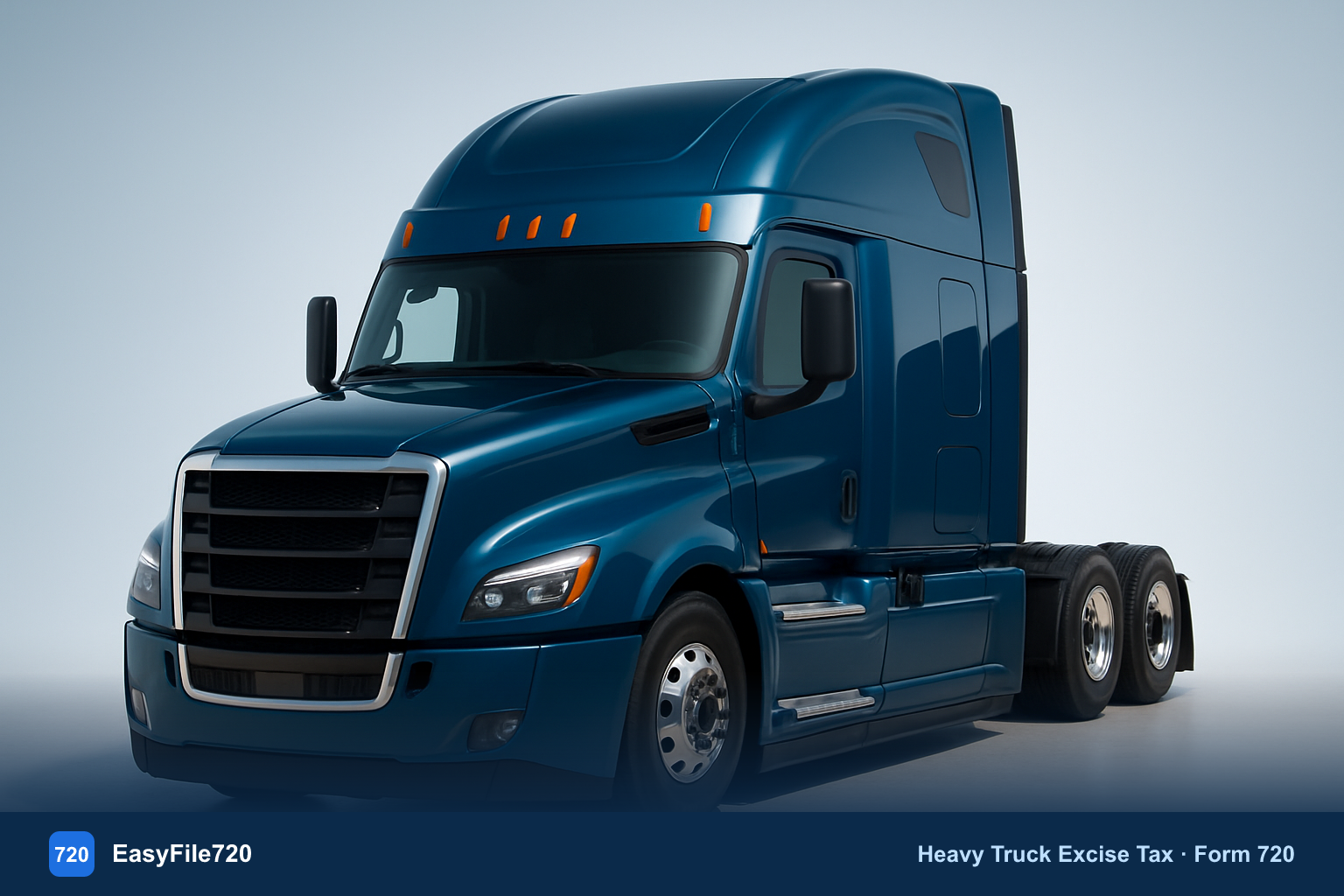
🚛 Quick Reference — Truck Tax 2026
What is the Federal Heavy Truck Excise Tax?
Under IRC section 4051, a 12% retail excise tax is imposed on the first retail sale of heavy trucks, trailers, semitrailers, and highway tractors above specified gross vehicle weight (GVW) thresholds. The tax is paid by the retailer (seller) and reported on Form 720.
Who pays the tax?
The retailer making the first retail sale is liable for the tax — typically truck dealers, manufacturers selling directly, or importers. The tax is usually passed to the buyer as part of the purchase price but is the seller's legal obligation to report and remit.
What is Gross Vehicle Weight (GVW)?
GVW is the maximum total weight of a loaded vehicle as rated by the manufacturer or seller. It is based on the chassis frame strength and axle capacity — not on the actual loaded weight. Readily attachable components like tires and rim assemblies are excluded.
Does the tax apply to parts & accessories?
Yes — parts and accessories sold on or in connection with a taxable vehicle are included in the taxable sales price. Exceptions: idling reduction devices and insulation with an R value of at least R35 per inch are excluded from the tax base.
What is the section 4051(d) tire credit?
A credit equal to the tire excise tax paid on each tire sold with the taxable vehicle may be claimed on Schedule C, line 14a. This prevents double taxation — the tire tax and truck tax both applying to the same tires. EasyFile720 supports this credit.
Which Vehicles Are Taxable vs. Exempt?
The tax applies based on gross vehicle weight. Vehicles below the threshold are exempt. Certain body types have additional size-based exemptions.
🚛 Truck Chassis & Bodies
GVW over 33,000 lbs. Suitable-for-use standard applies. Certain platform, van, dump, and refuse body types under size limits are excluded.
🚜 Trailer & Semitrailer Chassis & Bodies
GVW over 26,000 lbs. Trailers suitable for use with a vehicle at or below 26,000 lbs GVW are exempt.
🚚 Highway Tractors
GVW over 19,500 lbs and gross combined weight over 33,000 lbs. Tractors below either threshold are exempt.
Platform Truck Bodies ≤ 21 ft
Platform truck bodies 21 feet or less in length meet the suitable-for-use standard and are excluded.
Dry Freight / Refrigerated Van Bodies ≤ 24 ft
Dry freight and refrigerated truck van bodies 24 feet or less in length are excluded.
Small Dump & Refuse Bodies
Dump truck bodies ≤ 8 cubic yards and refuse packer bodies ≤ 20 cubic yards are excluded.
How to Calculate the Truck Excise Tax
The tax is straightforward: 12% × first retail sales price per vehicle. Enter each vehicle sold during the quarter and EasyFile720 totals them automatically.
| Vehicle Type | IRS No. | Tax Rate | Applied To |
|---|---|---|---|
| Truck chassis and bodies (GVW > 33,000 lbs) | 33 | 12% | First retail sales price |
| Trailer and semitrailer chassis and bodies (GVW > 26,000 lbs) | 33 | 12% | First retail sales price |
| Highway tractors (GVW > 19,500 lbs; GCW > 33,000 lbs) | 33 | 12% | First retail sales price |
📊 Calculation Example
A truck dealer sells three heavy trucks during Q2 2026 at prices of $120,000, $95,000, and $140,000.
Tax per truck: $120,000 × 12% = $14,400 | $95,000 × 12% = $11,400 | $140,000 × 12% = $16,800
Total Q2 tax liability: $14,400 + $11,400 + $16,800 = $42,600 — reported on IRS No. 33.
The dealer may also claim a Section 4051(d) tire credit on Schedule C, line 14a for the tire excise tax paid on each vehicle's tires.
Filing Truck Excise Tax on Form 720
EasyFile720 guides you through each vehicle sold, calculates the tax, applies any tire credits, and submits your quarterly return.
Create your account and select IRS No. 33
Sign up, enter your EIN and business details. Select the Retail Tax — Truck, Trailer, and Semitrailer category (IRS No. 33) for your quarter.
Enter each vehicle sold during the quarter
For each taxable vehicle, enter the sales price. EasyFile720 calculates 12% per vehicle and shows a running total for the quarter.
Claim the Section 4051(d) tire credit (if applicable)
If taxed tires were sold with the vehicle, enter the tire excise tax amount on Schedule C, line 14a. EasyFile720 walks you through the credit calculation.
Complete Schedule A and confirm deposits
Record your semimonthly net tax liability on Schedule A. If you've made EFTPS deposits, enter those on Part III line 5. EasyFile720 calculates your balance due.
Review, sign, and e-file to the IRS
Review your completed Form 720, sign electronically, and submit. We securely e-file it directly to the IRS.
Truck Excise Tax — Common Questions
Ready to file your truck excise tax?
Enter your vehicles sold, claim your tire credit, and e-file Form 720 — all in one guided workflow.