Indoor Tanning Tax Filing — Tanning Bed & Salon Excise Tax (Form 720, 2026)
Tanning salon owners and operators must collect a 10% federal excise tax on every taxable indoor tanning session and remit it quarterly on Form 720. EasyFile720 makes the quarterly filing fast and error-free — just enter your gross tanning receipts.
- 10% tax on indoor UV tanning services — IRS No. 140, Part II
- Tax is collected from the customer at point of sale
- Spray tans, lotions, and phototherapy are exempt — UV beds only
- Part II tax — no EFTPS semimonthly deposits required
What Indoor Tanning Services Are Taxable?
The 10% tax applies specifically to services using ultraviolet (UV) lamps — not to all cosmetic services marketed as "tanning." Knowing the line is critical to avoid over- or under-collecting.
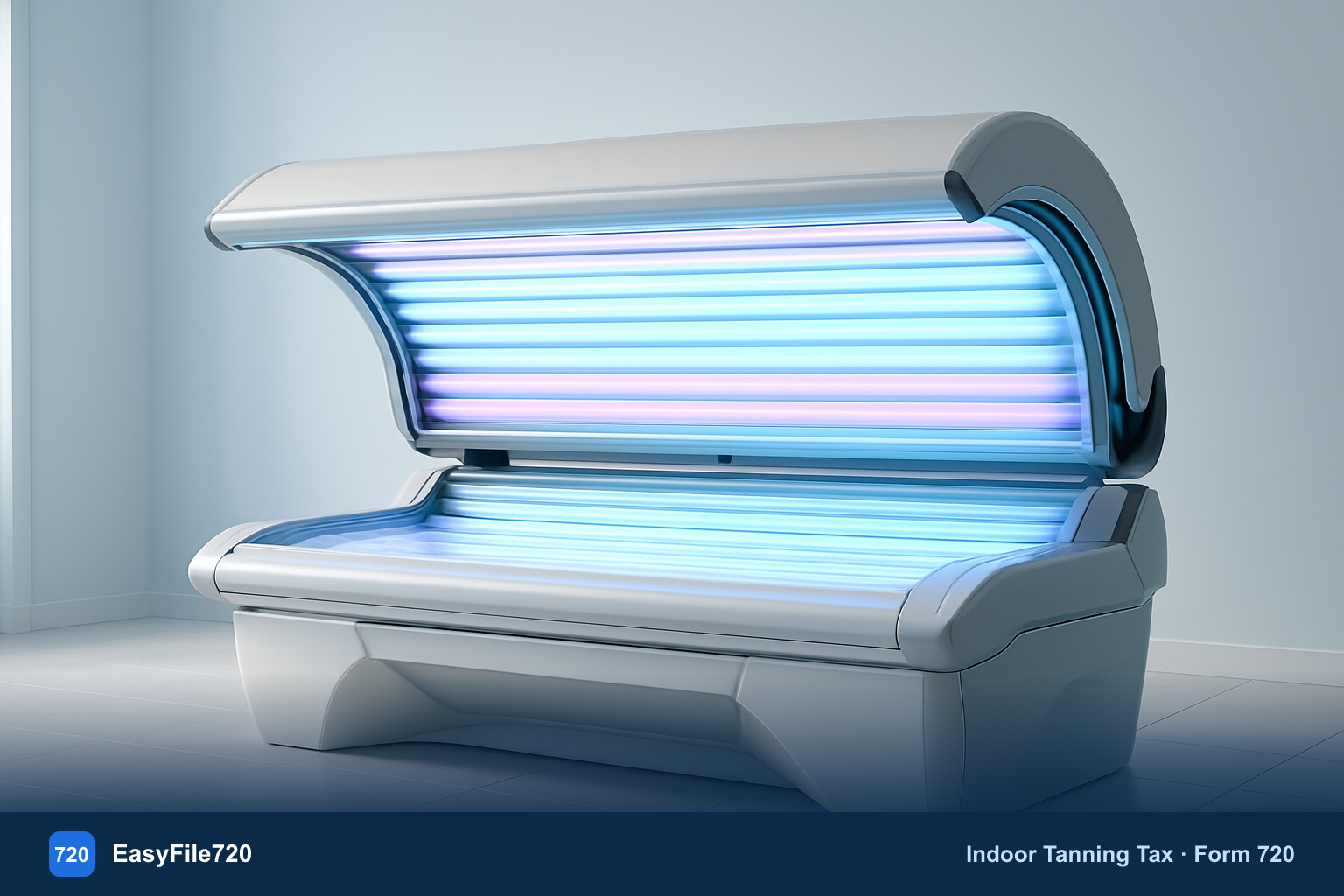
Any service using an electronic product with one or more ultraviolet lamps intended to induce skin tanning. This includes traditional horizontal lay-down beds, stand-up booths, and high-pressure UV equipment — all are subject to the 10% tax.
Examples: standard UV tanning beds, stand-up UV booths, high-pressure tanning units, bronzing beds
Spray tanning services using dihydroxyacetone (DHA) mist — whether applied in a booth or by a technician — do not use UV lamps and are not subject to the tanning excise tax. No tax is collected from spray tan customers.
Examples: spray tan booths, airbrush tanning, mystic tan, self-tanning lotion application services
Services performed by a licensed medical professional for the treatment of a medical condition — including psoriasis, eczema, jaundice, or seasonal affective disorder — are explicitly exempt from the tanning tax under IRC § 5000B(b)(2).
Examples: dermatologist UV phototherapy, neonatal bilirubin lights, SAD light therapy, vitiligo treatment
If a membership, package, or bundle includes UV tanning sessions, the portion of the payment attributable to UV tanning is taxable. If the tanning and non-tanning services are not separately priced, you must allocate the payment between taxable and non-taxable services on a reasonable basis.
Examples: monthly unlimited UV tanning memberships, session punch cards, spa bundles that include UV tanning
Bundled services require allocation: If you sell a package that includes both UV tanning and exempt services (e.g., spray tan + UV bed combo), you must reasonably allocate the total price between taxable UV tanning and exempt services. The IRS requires this allocation to be based on the standalone prices of each service. EasyFile720 prompts you to enter only the taxable portion of your receipts.
How the 10% Tanning Tax Is Calculated
The tax is 10% of the amount paid for the UV tanning service. It is collected from the customer at the point of sale and remitted quarterly to the IRS on Form 720.
| Service Type | IRS No. | Rate | Tax Base | IRC Section |
|---|---|---|---|---|
| Indoor UV tanning services | 140 | 10% | Amount paid for service | § 5000B |
| Spray tanning / sunless tanning | — | Exempt | — | § 5000B(b)(1) |
| Phototherapy (medical, licensed provider) | — | Exempt | — | § 5000B(b)(2) |
📐 Worked Example — Quarterly Tanning Tax Calculation
A tanning salon collects the following revenue in Q2 (April–June):
Enter your gross UV tanning receipts by month in EasyFile720 — the 10% is applied automatically. Spray tan and exempt service revenue is excluded before calculation.
Filing the Tanning Tax on Form 720
The indoor tanning tax is a Part II tax — simpler than Part I taxes, with no semimonthly EFTPS deposit requirement. Just file quarterly and pay with your return.
Separate taxable and exempt receipts
Gather your quarterly revenue records and separate UV tanning income from exempt services (spray tans, phototherapy, retail product sales). For bundled services, apply your allocation method to determine the taxable UV portion.
Enter gross UV tanning receipts in EasyFile720
Input your total taxable UV tanning receipts for the quarter. EasyFile720 automatically applies the 10% rate to calculate your IRS No. 140 liability and populates the correct line on Form 720, Part II.
Review and confirm your tax liability
EasyFile720 shows your total Part II tax owed. Unlike Part I fuel and truck taxes, Part II taxes do not require semimonthly EFTPS deposits — you pay the full balance with your quarterly Form 720 filing.
E-file and pay by the quarterly deadline
Submit your completed Form 720 electronically. Payment is made via EFTPS with your return. EasyFile720 e-files your return directly to the IRS.
📅 Quarterly Filing Deadlines
✅ No Semimonthly Deposits Required
The indoor tanning tax is a Part II excise tax. Unlike fuel and truck taxes (Part I), there is no requirement for semimonthly EFTPS deposits. You simply pay the full balance when you file your Form 720 by the quarterly deadline.
⚖️ ACA Origin
The indoor tanning tax was enacted as part of the Affordable Care Act (ACA) in 2010 under IRC § 5000B. It was originally conceived as a "Botax" on cosmetic surgery but was replaced with the tanning tax before passage. Revenue goes to the General Fund, not a dedicated trust fund.
Indoor Tanning Tax — Common Questions
More on the Indoor Tanning Tax
Guides on what's taxable, exemptions, bundled memberships, and a walkthrough for salon owners — plus the free tanning tax calculator.
Ready to file your tanning excise tax?
IRS No. 140, Form 720 Part II — file your quarterly tanning tax in minutes with EasyFile720.