Sport Fishing Equipment Excise Tax — Form 720, 2026
Manufacturers and importers of sport fishing equipment must collect and remit federal excise taxes on rods, reels, lures, flies, fishing tackle boxes, and electric outboard motors. EasyFile720 calculates your liability automatically from the manufacturer's price.
- All 4 IRS numbers (41, 110, 114, 42) in one filing
- Equipment (reels, lures) & rods/poles: 10%
- Tackle boxes & electric outboard motors: 3%
- Tax funds the Sport Fish Restoration Program (Dingell-Johnson Act)
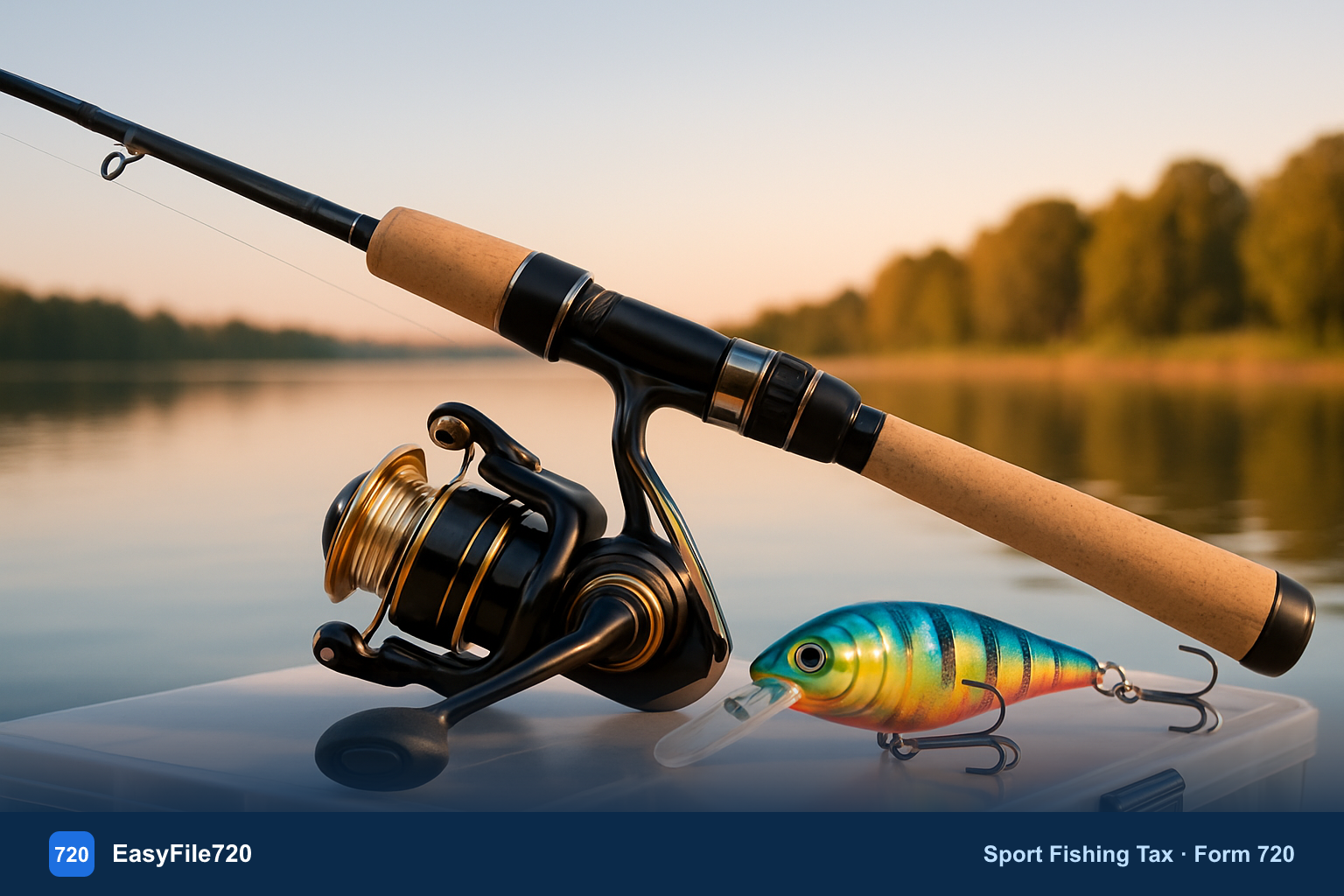
All Sport Fishing Equipment Covered by EasyFile720
Four IRS numbers apply to sport fishing equipment, split by product type. EasyFile720 guides you to the right line for each item you manufacture or import.
Applies to the first sale by the manufacturer or importer of sport fishing equipment other than rods and poles — including reels, artificial lures, flies, baits, and fishing lines. The tax is 10% of the price for which the article is sold.
Examples: spinning reels, baitcasting reels, fly reels, dry/wet flies, streamers, spinners, spoons, jigs, plugs, soft plastic baits, fly lines
Fishing rods and poles (and their component parts) are taxed at 10% of the first-sale price, but the tax on any single rod or pole is capped at $10 per article. The tax is paid by the manufacturer, producer, or importer.
Examples: spinning rods, casting rods, ice fishing poles, surf rods, fly rods, telescoping poles
Fishing tackle boxes are taxed at the lower rate of 3% (not 10%) of the first-sale price. A tackle box is a container designed to hold fishing tackle.
Examples: hard-sided tackle boxes, soft-sided tackle bags marketed as tackle boxes
Electric outboard boat motors are taxed at 3% of the manufacturer's or importer's first-sale price. Only electric motors qualify — gasoline outboards are not subject to this tax.
Examples: trolling motors, electric outboard propulsion motors, bow-mount electric motors, stern-mount electric trolling motors
Manufacturer or importer liability: These taxes are imposed on the manufacturer or importer at the time of the first sale to an unrelated buyer — not on the retailer or end consumer. If you manufacture fishing equipment in the U.S. or import it from abroad, you are responsible for collecting and remitting this tax on Form 720.
Complete 2026 Sport Fishing Equipment Rate Table
Tax is computed on the price for which the article is sold (net of separately stated installation, delivery, and warranty charges where allowed).
| Article / Equipment | IRS No. | 2026 Rate | Tax Base | IRC Section |
|---|---|---|---|---|
| Sport fishing equipment (reels, lures, flies, lines) | 41 | 10% | Sales price | § 4161(a)(1) |
| Fishing rods and poles | 110 | 10% (max $10/article) | Sales price | § 4161(a)(1) |
| Fishing tackle boxes | 114 | 3% | Sales price | § 4161(a)(1) |
| Electric outboard motors | 42 | 3% | Sales price | § 4161(a)(2) |
Tax base — "sales price" defined: The taxable sales price generally means the total amount paid by the purchaser, including charges for coverings, cases, and packaging, but excluding separately stated charges for delivery, installation, or warranty. Where a manufacturer sells to a related purchaser at a favorable price, the IRS may substitute the fair market price. EasyFile720 prompts you to enter the correct taxable sales amount per sale batch each quarter.
Who Is Required to File?
The sport fishing equipment excise tax applies broadly to U.S. manufacturers and importers — not just large companies.
U.S. Manufacturers
Any person who manufactures fishing rods, reels, lures, tackle boxes, or electric outboard motors domestically and sells them to the first buyer (including retailers or distributors).
Importers
Any importer who brings taxable fishing equipment into the U.S. for sale. The tax liability attaches at the point of first sale to an unrelated buyer after importation.
Private-Label Sellers
Retailers or brands that import fishing equipment under their own label are treated as importers and are responsible for the tax, even if they don't engage in physical manufacturing.
Retailers are NOT liable. If you are a retail store that purchases fishing equipment from a domestic manufacturer or an importer who has already paid the excise tax, you do not file Form 720 for these items. The tax is passed through in the product price by the time it reaches you.
Filing Sport Fishing Equipment Taxes on Form 720
Sport fishing equipment taxes are Part I taxes — filed quarterly, with semimonthly EFTPS deposits required if liability exceeds $2,500 per quarter.
Identify your taxable equipment categories
Select which product types you sold this quarter — equipment such as reels and lures (IRS No. 41), rods & poles (No. 110), tackle boxes (No. 114), and/or electric motors (No. 42). EasyFile720 shows only the lines relevant to your selections.
Enter total taxable sales for each category
Input the aggregate first-sale price for each IRS number. EasyFile720 automatically multiplies by the applicable rate — 10% for sport fishing equipment (No. 41) and rods & poles (No. 110); 3% for tackle boxes (No. 114) and electric motors (No. 42).
Review your Part I tax liability
EasyFile720 totals your sport fishing equipment tax alongside any other Part I taxes you owe, checks for EFTPS deposit requirements, and flags if semimonthly deposits are due.
Complete Schedule A & submit
Record your semimonthly tax liabilities on Schedule A, confirm your EFTPS deposits match, then e-file your Form 720 to the IRS. EasyFile720 handles the Schedule A calculation automatically.
📅 Quarterly Filing Deadlines
⚡ EFTPS Deposit Requirement
If your total Part I net tax liability exceeds $2,500 for the quarter, semimonthly EFTPS deposits are required. Deposits are due by the 14th day following each semimonthly period. EasyFile720 tracks your Schedule A liability and alerts you when deposits are required.
🎣 Sport Fish Restoration Fund
Revenues from IRS Nos. 41, 110, 114, and 42 are deposited into the Sport Fish Restoration and Boating Trust Fund under the Dingell-Johnson/Wallop-Breaux Act. Funds are distributed to state fish and wildlife agencies for fisheries management, boating access, and aquatic education programs.
Sport Fishing Equipment Tax — Common Questions
Ready to file your sport fishing equipment taxes?
IRS Nos. 41, 110, 114, and 42 — all four covered in one guided quarterly filing workflow.